
Tehama County Scheduled Release
The Tehama Sheriff current-inmates listing can show a Scheduled Release Date for someone still in county jail custody. That field is useful, but it is not the same thing as a final release confirmation. The public source is a current-custody roster. When a person leaves the roster, the web page does not become a rolling archive of released inmates.
A scheduled date is best understood as an operational custody field. The Tehama custody manual says release staff review the active file for release-date calculations and good-time adjustments before release. Staff also confirm release paperwork, identity, warrants, detention orders, property, account status, and special release planning. Release can also wait during count, shift change, or unsafe movement conditions. Those local checks explain why a visible date can differ from the actual time a person walks out.
The manual adds several local timing limits. End-of-term and court-ordered releases are scheduled at staggered times on the release date so the release area does not become congested. Staff escort a scheduled release to the transfer and release area 30 minutes before the scheduled time. The same policy says people are not released or moved during count, shift change, or when movement would create a safety threat or disrupt facility operations. A Tehama scheduled release date is therefore a date field plus an operational process, not a public appointment time.
Check a Tehama Release Date
Use a different route for county jail, CDCR, federal, or supervision cases. The Tehama current inmate listing is the local custody source for someone still in the Tehama County Jail. CDCR CIRIS is the state prison route for a person sentenced to CDCR or housed at Salt Creek Conservation Camp #7 or Ishi Conservation Camp #18. Court records are often the best way to explain why a release happened.
For Tehama jail cases, the court record can explain a date change that the roster cannot. The Tehama Superior Court criminal record may show bail, release orders, custody credits, sentence, dismissal, probation, mandatory supervision, or a future hearing. It can also show whether the person was committed to CDCR, which changes the date source from the Sheriff roster to CDCR CIRIS and BPH date labels. If the case moved to a federal track, the BOP locator or PACER may be needed instead.
- Start with the Sheriff current-inmates page to see whether the person is still listed in county jail custody.
- Look for the scheduled release field and note the booking date, charges, bail, and any detail-page fields that are visible.
- Search the Tehama court self-service record for bail, release orders, sentence, custody credits, probation, dismissal, or warrants.
- Use CDCR CIRIS for state prison or conservation camp cases and compare CDCR number, age, commitment county, location, and date labels.
- Register or check California VINE status for a custody-change signal, then confirm the exact release reason through the agency record.
For a full named-person search path after release, use the Tehama County released inmate lookup and then return to the date source that matches the case.
CDCR Release Date Labels
California does not use one simple public label for every projected release date. The Board of Parole Hearings identifies several date concepts. EPRD, or Earliest Possible Release Date, applies to determinate sentences and reflects the sentence less applicable credits. MEPD is the Minimum Eligible Parole Date for many indeterminate life cases. NPED is a nonviolent parole eligible date under Proposition 57. YPED and EPED apply to youth and elderly parole eligibility in specific statutory settings.
For Tehama County, these labels matter when a Tehama Superior Court sentence sent the person to CDCR, when the person is in a CDCR conservation camp located in the county, or when CDCR parole or PRCS follows the prison release. A CIRIS no-result should not be treated as proof of release. The person may be in county jail, discharged from CDCR, in federal or immigration custody, recently transferred, or listed under a different name.
BPH states that when more than one parole or release-eligibility date applies, the controlling parole eligible date is the earliest applicable opportunity for parole consideration or release. That distinction matters for Tehama users because a person may have a determinate sentence date, a nonviolent parole eligible date, a youth parole date, or an elderly parole date. The label tells the reader what kind of release process is involved. A parole-eligible date is not always the same as the day of physical release.
| Date label | Where it fits | How to read it |
|---|---|---|
| EPRD | Determinate CDCR sentence | Earliest possible release based on sentence and credits. |
| MEPD | Indeterminate life sentence | Minimum date for parole consideration. |
| NPED | Eligible nonviolent parole review | Proposition 57 parole eligibility date. |
| YPED | Youth offender parole | Eligibility tied to age at controlling offense and sentence type. |
| EPED | Elderly parole | Eligibility tied to elderly parole rules and exclusions. |
The CDCR CIRIS search home is shown in the manifest image below. It is the state route, not the Tehama jail roster route.
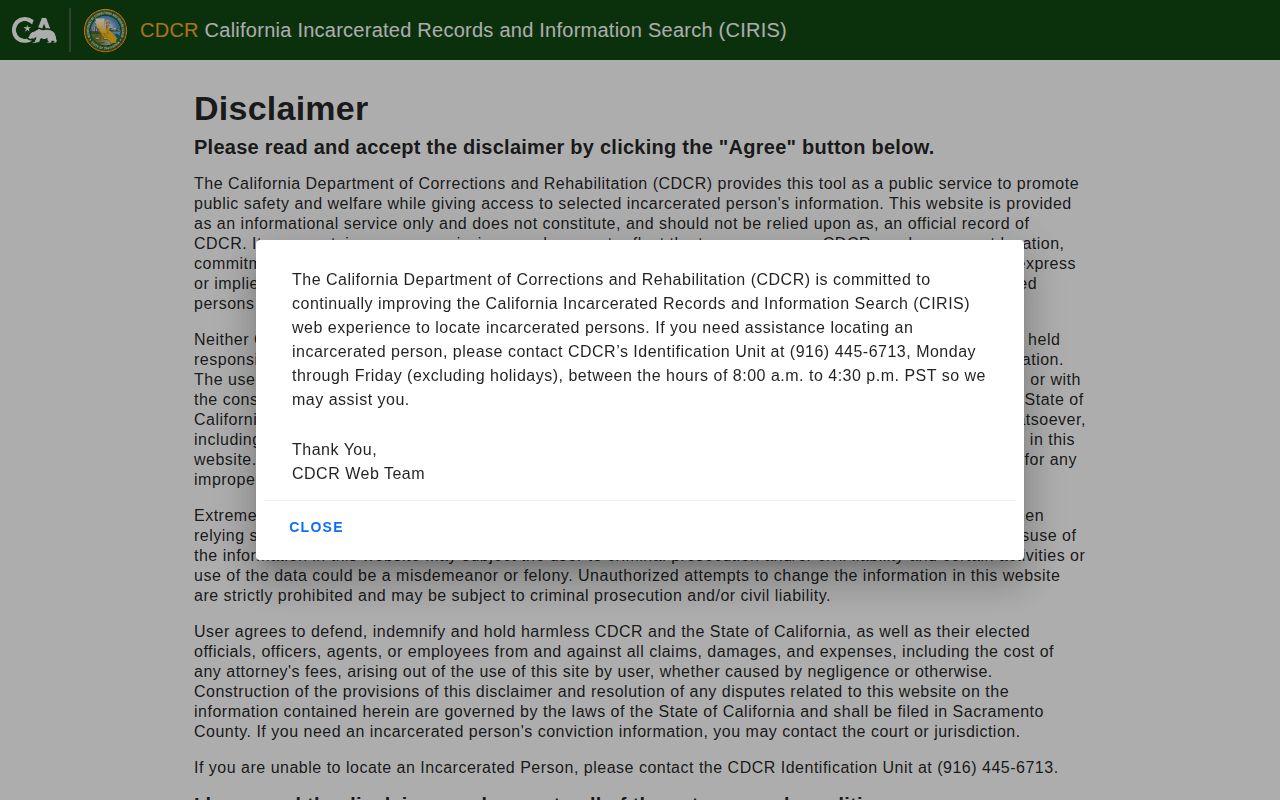
Use CIRIS with the court case when a Tehama County release-date question involves state prison, parole eligibility, or a conservation camp.
Tehama County Good-Time Credits
Good-time and work-time credits can affect a Tehama County release date, but the calculation is not a public web calculator. Penal Code section 4019 governs conduct credits for many local custody settings, including county jail and related local facilities, subject to exclusions and changes in law. Tehama's custody manual localizes that rule by requiring release staff to review good-time calculations and release-date adjustments before release. It also allows inmate worker incentives through Good Time and Work credits when state or local law allows sentence reduction.
CDCR credits work differently. CDCR's published credit sources identify Good Conduct Credit, Milestone Completion Credit, Rehabilitative Achievement Credit, Educational Merit Credit, and Extraordinary Conduct Credit. Good Conduct Credit can depend on workgroup and violent or nonviolent status, and it can be forfeited for discipline. Conservation camp credit rates may differ from other groups, which matters for people housed at Salt Creek or Ishi.
CDCR's current examples include different Good Conduct Credit rates for eligible nonviolent groups, violent categories, minimum custody, and conservation camp workers or trainees. The conservation camp detail is especially relevant in Tehama County because Salt Creek and Ishi are CDCR/CAL FIRE camps inside the county. A person working in a camp may be physically in Tehama County but legally in state custody, so the credit and release-date question belongs to CDCR records rather than the county jail records unit.
The CDCR Good Conduct Credit FAQ was captured for this topic and appears below. It should be read as state prison credit guidance, not as a direct Tehama jail release-date calculation.
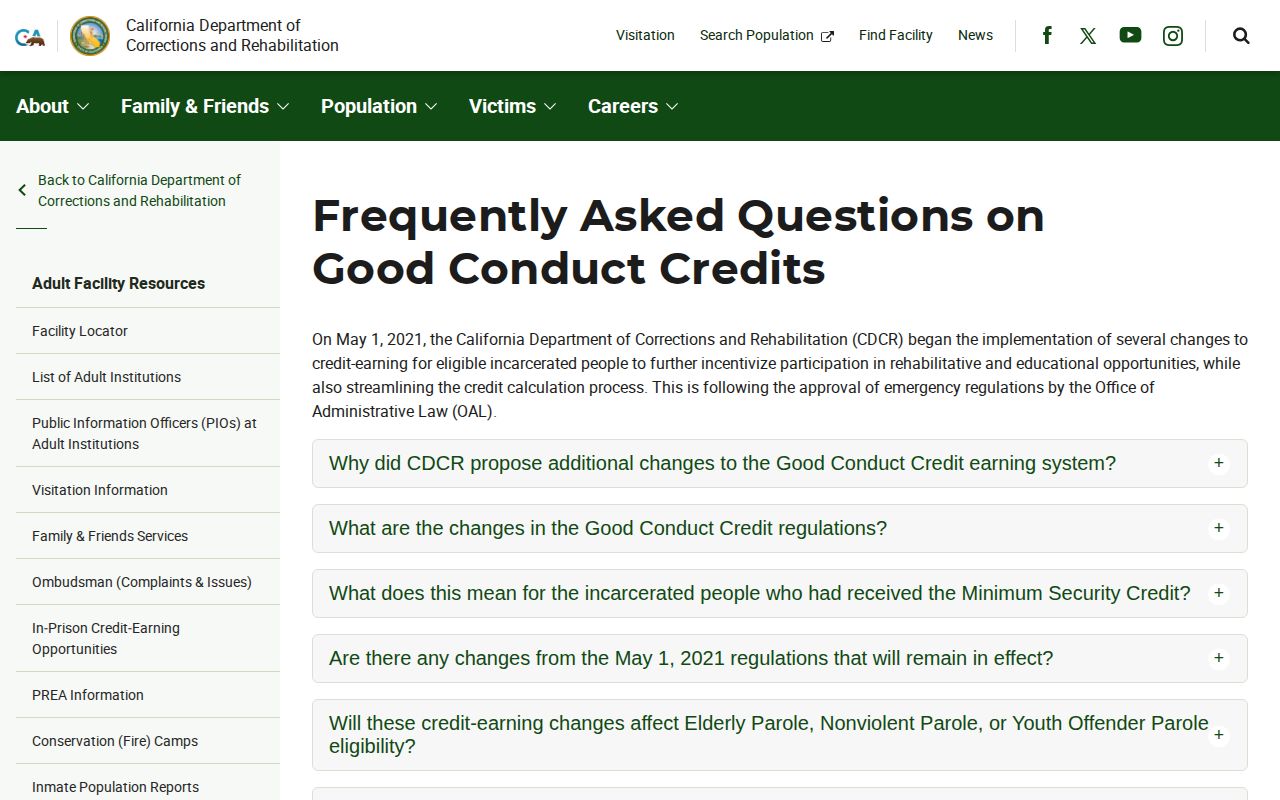
California Penal Code section 2933.1 is also important. It limits worktime credit to no more than 15 percent for people convicted of qualifying violent felonies listed in Penal Code section 667.5(c). That is the source of the common 85 percent shorthand, but it is not a rule for every sentence.
Why Tehama Release Dates Change
A projected or scheduled release date can move for legal, credit, transfer, and operational reasons. In Tehama County Jail cases, the court can change custody status through bail, dismissal, sentence, or a release order. In CDCR cases, credits, classification, program awards, parole eligibility, and hearing outcomes can change the projected timeline. In both systems, warrants or holds can block physical release even after the original sentence date arrives.
Tehama's release process also includes checks that happen close to the scheduled release. Staff verify identity against intake records, including name, photograph, facility identification number, or a fingerprint match when available. They review active release-authorizing documents and check for unresolved release issues such as medication arrangements, referrals, grievances, damage claims, or lost property. NCIC and local warrant checks occur before release. If another agency has charges, jail staff notify that agency that the person is available for release.
Medical and service planning can also affect timing in narrow cases. The custody manual says people with severe mental illness should, when reasonably practicable, be released during business hours so services can be accessed right away. It also describes a voluntary short stay for some people eligible for release who have mental illness or substance addiction, so discharge can occur to a treatment center or during daylight hours. That is another reason a scheduled date may not answer the exact release-time question.
| Change factor | Where it appears | What to confirm |
|---|---|---|
| Court order | Tehama Superior Court | Bail, dismissal, sentence, resentencing, release order, or warrant status. |
| Credits | Jail file or CDCR record | Good-time, work-time, program credit, forfeiture, or restoration. |
| Hold or detainer | Jail, court, agency record | Another county, state, federal, or immigration custody path. |
| Transfer | Jail, CDCR, VINE | Move from county jail to CDCR, another county, BOP, or ICE. |
| Release processing | Tehama custody records | Identity check, paperwork, count, shift change, safety, or medical planning. |
Pretrial vs Sentenced Release
A pretrial detainee at Tehama County Jail usually does not have a reliable projected release date in the same sense as a sentenced inmate. Release can happen after bail, bond, citation release, a court order, dismissal, time-served decision, or another agency pickup. The jail roster may list bail and a scheduled release field when available, but the court file is the better source for why the person can leave.
A sentenced jail inmate may have a scheduled release date that accounts for local credits and the sentence imposed. A CDCR prisoner may have an EPRD or parole eligibility label that depends on state prison law, CDCR credits, and BPH rules. These tracks should not be mixed. Post-release supervision records explain what happens when the release leads to parole, PRCS, mandatory supervision, or probation.
Bond and self-bail are another reason a Tehama date can change quickly. The custody manual says inmates arranging bail may be allowed a reasonable amount of time, at the shift supervisor's discretion, to make telephone calls before placement in general population. It also describes an Authorization for Self-Bail process using an inmate-account transaction and receipt. In that setting, the court case continues even though the person may leave jail custody before any sentenced-release calculation applies.
Note: If the person is no longer on the Tehama current roster, confirm release through VINE, court, CDCR, or the Sheriff's Records Division before assuming the destination.