
Tehama County Supervision Paths
Post-release supervision in Tehama County is not one system. California separates state parole from county-supervised PRCS, mandatory supervision, and ordinary probation. CDCR Division of Adult Parole Operations, or DAPO, supervises some people released from state prison. Tehama County Probation supervises local probation, mandatory supervision, and PRCS. The court record decides many local cases, while CDCR and the Board of Parole Hearings shape many prison cases.
The key first step is to identify the custody path. A person released from the Tehama County Jail after a local case may be on probation only if the court ordered it. A person leaving CDCR custody from a Tehama case, Salt Creek Conservation Camp #7, or Ishi Conservation Camp #18 may report to DAPO parole or to Tehama County Probation for PRCS. The Tehama Probation AB 109 page is the local source for PRCS and mandatory supervision, while CDCR parole covers the state parole track.
CDCR's PRCS material makes the split concrete. Penal Code section 3451 sends many eligible prison releases to a county agency after October 1, 2011. CDCR keeps DAPO parole for listed groups such as current serious felony terms, current violent felony terms, life terms under specified statutes, High Risk Sex Offender classification, and Offender with Mental Health Disorder status. Tehama County Probation then becomes the local point for PRCS cases that do not stay with DAPO. That is why a released Tehama person can be out of CDCR custody yet still have active county supervision.
| Supervision type | Who handles it | What it means after release |
|---|---|---|
| Parole | CDCR DAPO | State prison release supervised by state parole when CDCR criteria apply. |
| PRCS | Tehama County Probation | Eligible prison release discharged from CDCR and supervised by the county under Penal Code section 3451. |
| Mandatory supervision | Tehama County Probation | Split sentence under Penal Code section 1170(h)(5)(B), with part in custody and part under probation supervision. |
| Probation | Tehama County Probation | Court-ordered local supervision after a Tehama criminal case. |
Verify Tehama County Supervision
A released person may be off the jail roster and still have an active supervision duty. That is why the current-inmates list is only a custody signal. For a local jail release, the Tehama Superior Court case and probation office are stronger sources. For a prison release, CDCR CIRIS, Board of Parole Hearings records, and the parole or PRCS office help explain whether the person is on DAPO parole or county supervision.
The Tehama Superior Court record is often the bridge between custody and supervision. Court entries can show probation orders, split sentences, sentence completion, custody credits, release orders, and warrant status after the jail roster no longer lists the person. If the case was sent to CDCR, the court record can identify the commitment county and sentence, while CIRIS and BPH records explain the state custody or parole-eligibility side. If the court ordered local probation, the Probation Department is the better channel than CDCR.
- Check the Tehama Sheriff current-inmates page only to see whether the person is still shown in jail custody.
- Search the Tehama court self-service record for release orders, sentence terms, probation, mandatory supervision, warrants, or future hearings.
- Use CDCR CIRIS if the person was sentenced to state prison or housed in a Tehama conservation camp.
- Contact the CDCR Red Bluff parole office for state parole routing, or Tehama Probation for PRCS, mandatory supervision, and local probation.
- Use California VINE for custody-change signals, then confirm the legal status with the agency or court record.
Tehama County Supervision Offices
Tehama has two practical office routes for post-release questions. CDCR's Northern Region directory lists a Red Bluff parole office for state parole. Tehama County Probation lists its main office and its AB 109 supervision work for PRCS and mandatory supervision. The local distinction matters because CDCR says eligible PRCS releases are discharged from CDCR and are no longer under CDCR jurisdiction once released to the county.
The Tehama County Probation Department lists Pamela Gonzalez as Chief Probation Officer and provides the main department contact. The AB 109 unit is tied to the Day Reporting Center and supervises people who, before realignment, might have been sentenced to state prison or state parole. That means a Tehama release from state custody can still be a county probation question.
Tehama's AB 109 description also gives two local definitions that prevent common mistakes. PRCS covers people released from state prison who, based on the committing offense, go to county supervision rather than state parole. Mandatory supervision is the community portion of a split sentence under Penal Code section 1170(h)(5)(B), where part of the sentence is served in local custody and the rest is supervised by Probation. Those labels are release-status terms, not facility names.
CDCR Red Bluff Parole Office
10 Gilmore Road, Suite C
Red Bluff, CA 96080
530-529-7700
CDCR Northern Region directory
Tehama County Probation Department
1840 Walnut Street
Red Bluff, CA 96080
530-527-4052
Monday-Friday, 8:00 a.m.-5:00 p.m.
The Adult Day Reporting Center is also a local supervision point. The re-entry resources material identifies the DRC Work Release and Education Program at 780 Antelope Boulevard in Red Bluff as a cooperative program between the Sheriff's Office and Probation Department. Community-service sign-up days are listed by Probation as Tuesday and Wednesday mornings.
The Tehama Probation AB 109 page is shown in the captured source image below. That source is useful because it names PRCS and mandatory supervision as county-level supervision tracks, not jail custody statuses.
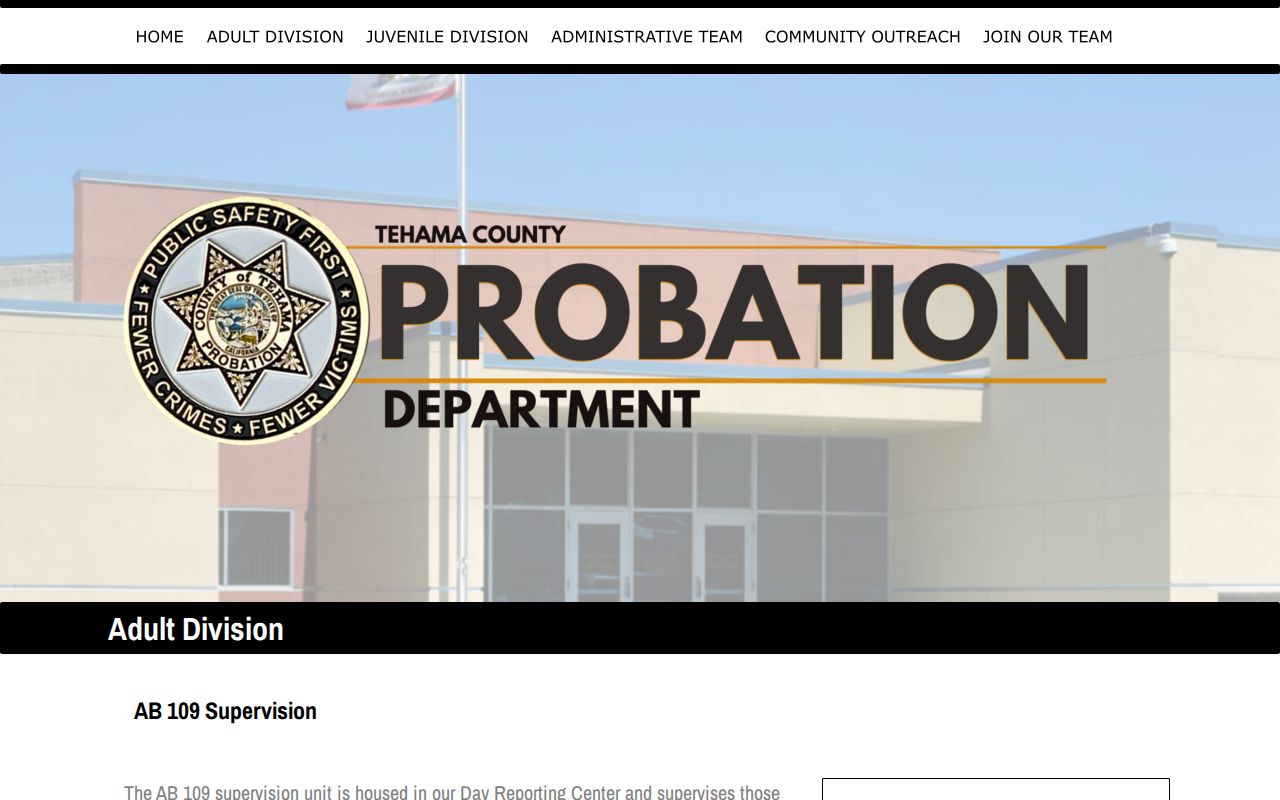
Use that page with the court record when a release appears to route to PRCS, mandatory supervision, or a split sentence after custody.
Tehama County Release Terms
Supervision terms are the rules attached to a release. They can include reporting, treatment, no-contact orders, search terms, work or program duties, court dates, and other case-specific limits. The exact terms come from the court, CDCR, parole, or probation record. A public roster will not show the full set of terms, and VINE will not decide whether a violation has occurred.
- Parole
- State supervision after a qualifying CDCR prison release.
- Probation
- County court supervision that may follow a local conviction or sentence.
- PRCS
- Postrelease community supervision by the county after an eligible prison release.
- Mandatory supervision
- The community-supervision portion of a split local sentence.
- Absconder
- A supervised person whose whereabouts or reporting status is unresolved under the supervising agency's rules.
No Tehama County Probation public absconder list or sheriff warrant list tied to released inmates was found in the research. That absence should not be treated as proof that no warrant or violation exists. The Tehama custody manual says release staff complete NCIC and local warrant checks before release, and if another agency has outstanding charges, staff notify that agency that the person is available for release. After release, the court and the supervising office are the better public channels.
VINE can help with custody changes, but it is not a supervision file. California VINE may show a status change, transfer, or release event for a county jail or CDCR record. It will not explain whether a Tehama release was followed by probation, PRCS, a BPH grant, or a violation process. For that, match the VINE signal to the court case, the CDCR record, and the supervising office that owns the release track.
Tehama County Parole Hearings
The California Board of Parole Hearings matters when a Tehama-connected person has a CDCR case, a life or parole-eligible sentence, a hearing date in CIRIS, or a custody history at a state facility such as Salt Creek or Ishi. BPH is not the route for an ordinary Tehama jail bond release or a local probation case. It is a state parole and parole-eligibility source.
BPH publishes a hearing schedule and states that schedules are updated weekly on Thursday morning. The schedule can show monthly hearing lists, whether a hearing is in person or by video, and the date, time, and location. BPH also publishes hearing results. Results can include grants, denials, waivers, postponements, continuances, rescissions, or other board actions. A grant does not always mean same-day physical release because review periods, holds, or release processing can still apply.
The BPH schedule source is shown below from the manifest capture. It belongs on a Tehama supervision page only when the person has a CDCR or BPH path, not when the release was a short local jail stay.
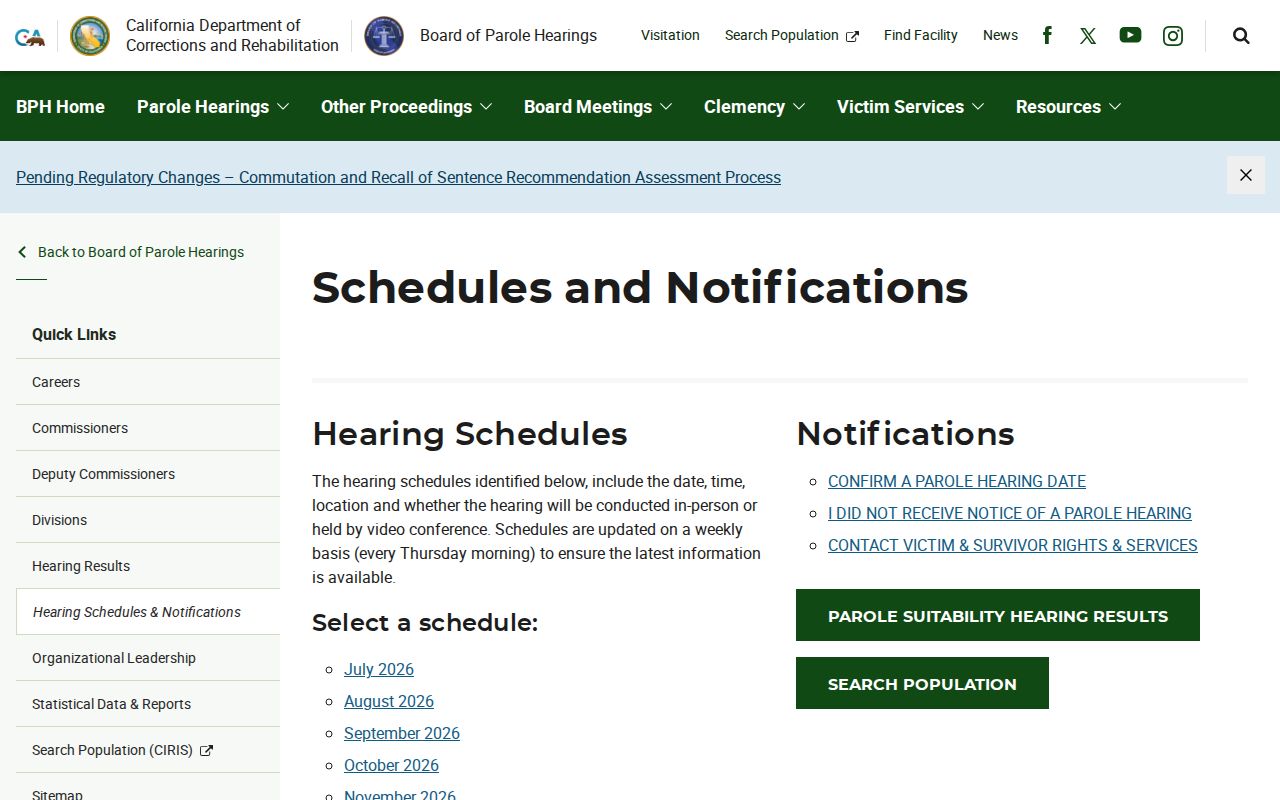
Pair any BPH entry with CDCR CIRIS and, if release has already happened, the correct parole or PRCS office.
Property and Reentry After Release
Tehama has a local reentry layer around probation, PRCS, and jail release logistics. The re-entry resources PDF identifies the DRC Work Release and Education Program as a Sheriff's Office and Probation Department program at the Day Reporting Center. It is described as an alternative custody program that helps with jail crowding while providing services and programs. That makes the DRC a real local reference point for people trying to understand a release that leads into community supervision.
The Tehama custody manual also gives useful release-day details. Personal property is returned during release, with the released person signing a receipt. If there are property issues, they are reported to the shift supervisor. The manual also describes inmate-account handling at release, including a scheduled-release roster, adjustment of the account to zero, and release of money after the account report is endorsed. These details do not prove supervision status, but they explain why release confirmation can involve both custody records and post-release office routing.
Note: For a named release, use Tehama County released inmate search paths with the court and agency record, not the current roster by itself.